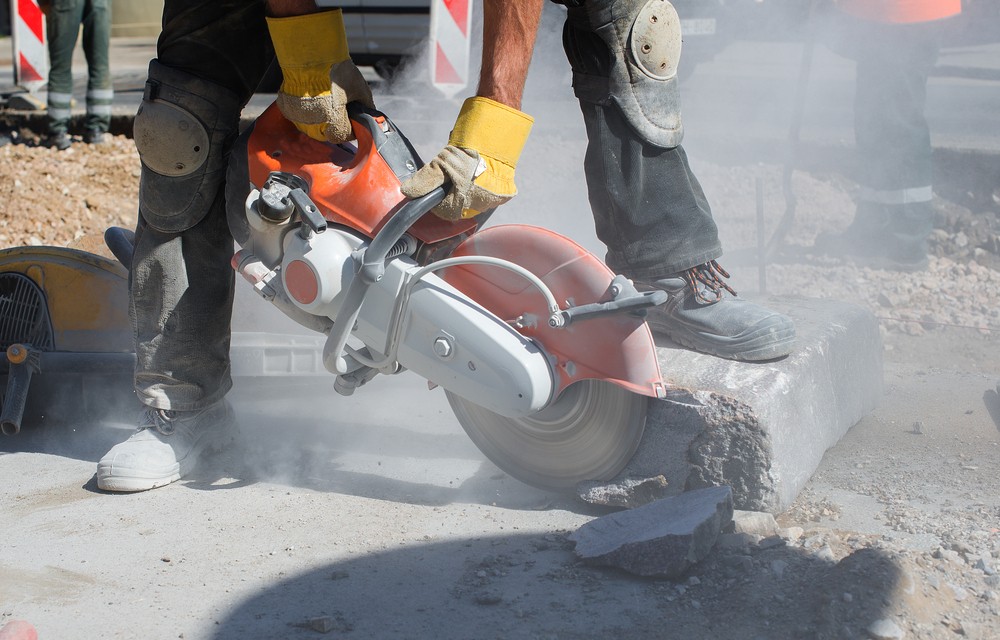
Are you involved in dry concrete cutting? Are you aware of the risks associated with dry concrete cutting? If not, you need to read this article today!
People who are involved in concrete cutting are at high risk of numerous hazards while dry concrete cutting is associated with health risks, too.
Toxic exhaust fumes, saw kickback, blade fracture, and silica dust are some of the many hazards of concrete cutting. Concrete cutting devices are vulnerable to violent pressure when the blade jams inside a cut.
This article provides information on some of the various risks involved with dry concrete cutting.

  • Silica Dust
  • Damaged Or Inappropriate Blade
  • Blunt Cutting Edges
  • Kickback And Push-Back
  • Power Cords

Silica Dust

Concrete cutting can be a dirty job with workers being exposed to clouds of silica dust regularly - especially when using dry cutting methods. Silica dust poses massive health risks for employees on the job.
Concrete contains a compound known as crystalline silica. Silica can be a major health concern when exposed in the air. Crystalline silica is found in many other compounds such as sand, slate, flint, and quartz.
It doesn't pose any risk unless the dust is exposed in the air. This happens when concrete is cut with a saw, is ground or crushed.
Construction workers can develop silicosis when exposed to silica dust regularly. It's a non-curable lung disease that occurs when silica dust accumulates in the lungs.
Scar tissue will form in the lungs when silica dust embeds itself in the lungs. This reduces the lung's ability to take in oxygen.
Symptoms of the condition won't develop for at least five years and may take only two more years for the individual to become disabled or in extreme cases, cause death.
That's why you need to take appropriate safety measures when you are involved in dry concrete cutting.

Damaged Or Inappropriate Blade

When the cutting device uses an inappropriate or damaged blade, it can vibrate, shatter, wobble, fragment or even fly off. Such a blade will disintegrate when force is applied to it.
This can result in accuracy issues with the actual cuts.
That's why you need to avoid situations of cutting concrete with cutters that have damaged or inappropriate blades. The correct blade should be used and installed properly.
Never cut concrete with a damaged blade because it can cause injuries to construction workers.

Blunt Cutting Edges

Blunt cutting edges are common when you rely on a saw blade with a wrong diamond cutting bond. The bond will hold the cutting diamonds together too hard and may lead to a delay in the cutting process.
The surface diamonds in the blade will get blunt in no time under such circumstances. You may have to apply some additional force when using a handheld saw.
Blunt edges can lead to push-back, kickback or pull-in of the concrete saw. Make sure the blade is sharp enough when you are involved in dry concrete cutting.

Kickback And Push-Back

These forces are suddenly experienced by the saw operator and could be difficult to manage. This may lead to injuries and other health hazards.
Kickback and push-back can wrench the concrete saw from its fittings and leave it running on the ground. You should be aware of these hazards to prevent any injuries caused by them.

Power Cords

Power cords can be easily damaged when linked with electric-powered cutting devices and other equipment. The exposed wire can result in electrocution hazards when exposed to water so extreme care needs to be taken.

If you are looking for a concrete cutting company that is trustworthy and reliable, then don’t go past VIC Sawing and Drilling. Call us today on (03) 8786 3621 or through our contact page

Read more

Are you looking for the best blade for your next concrete cutting project? Do you know much about the different types of concrete cutting blades? If not, please keep reading to learn more.
When it comes to concrete sawing, choosing the right concrete cutting blade could be the difference between an efficient and cost-effective concrete cutting project and one that costs you a fortune to complete.
That's why you should choose the right concrete cutting blade for your next concrete cutting project. This article provides information on different types of concrete cutting blades for you to choose from.

  • Dry Cutting Blades
  • Laser-Welded Diamond Blades
  • Wet-Cutting Diamond Blades
  • How To Choose The Right Blade For Your Project?

Dry Cutting Blades

Dry-cutting blades are some of the most popular concrete cutting blades out there. They are mostly used to cut dry and hard concrete. Dry-cutting blades are made from high-density alloys of diamond and silver.
Dry cutting blades come in two types such as hot-pressed and cold-pressed blades. Cold-pressed diamond blades have low-density segments with high porosity.
This feature is essential to enhance the cooling effect when the blade is in use. These blades can cut granite, marble, asphalt, concrete, ceramic, and most of the other dry materials.
Cold-pressed blades have a shorter service life compared to hot-pressed concrete cutting blades. Hot-pressed blades are the other type of dry cutting blade. It's well-alloyed and comes with high-density segments and longer service life.

Laser-Welded Diamond Blades

Laser-welded diamond blades can be used for wet and dry cutting. These blades are made by fusing the diamond segments and steel with laser welding.
The diamond and steel materials are melted and formed a high strength connection to withstand high temperatures when being used for dry cutting projects.
Laser-welded diamond blades should be ideally used for wet cutting projects or with a lot of water. Regular dry cutting can make the connection between the diamond segments and the steel core to wear off quickly. This can damage the blade before long.

Wet-Cutting Diamond Blades

Wet cutting blades are used to cut green concrete with water being used to cool the blades of this cutter. Diamond saw blades with a silver coating are used in wet concrete cutting.
This blade cannot be used for dry cutting projects because the high temperatures generated during such projects could melt the silver coating of the blade.

How To Choose The Right Blade For Your Project?

When you know about the different types of concrete cutting blades out there, it's easy to choose the right type of blade for your concrete cutting project.
The material you plan to cut can affect the cutting speed and the life of the blade. Although most blades are designed to cut a wide range of materials, they are limited by the hardness of the bond and the diamond quality used.
The blade should match the material it cuts for the best performance of the blade. Diamond blade manufacturers usually specify what type of aggregate their blade would cut.
You need to closely follow the instruction manual when using a diamond blade when cutting different types of concrete materials.
The type of equipment you use will have an impact on the cutting project. For example, a 5-hp cutter and a 70-hp cutter will use different blades.
The RPMs needed to spin the blade, the size of the blade, and the cutting method - whether wet or dry will depend on the type of concrete cutter you use.

If you are looking for a concrete cutting company that is trustworthy and reliable, then don’t go past VIC Sawing and Drilling. Call us today on (03) 8786 3621 or through our contact page

Read more

Are you searching for a quality blade for your next concrete cutting project? Do you know the advantages of using a diamond saw blade for concrete cutting? If not, you need to keep reading below.
When it comes to concrete cutting, there is nothing like a diamond saw blade. Diamond saw blades are the king of the concrete cutting industry. Diamond blades are some of the most advanced concrete cutting blades on the market today.
Diamond blades deliver a superior level of performance at an affordable cost compared to other types of concrete cutting blades on the market.
That's why you need to choose a diamond saw blade for your next concrete cutting project. Let's take a look at some of the reasons why you should choose a diamond blade below:

  • Speed
  • Durability
  • Precise And Smooth Cutting
  • Comfortable To Use

Speed

Speed is important in any concrete cutting project. The faster you finish the cutting, the better your chances of earning more money are in the process.
In today's competitive business environment, you need to stand out from the rest of the competition to attract more clients and get more concrete cutting projects. The diamond saw blade is your best bet to finish your project faster.
You can use the turbo blade design to cut concrete faster. Turbo blades come with a continuous outer rim with a serrated edge which helps the blade withstand high speeds while still being precise.
You can expect a high-quality performance from a diamond blade due to this feature.

Durability

Diamond saw blades are extremely durable compared to other types of concrete cutting blades on the market. The diamond blade is made using a circular steel disk with segments on the outer edge.
These segments are made from a combination of diamonds and metal bond powder. They are fused under high pressure and heat. This process not only makes the blade efficient but also very durable.
Diamond is the strongest element on earth and will last for decades without losing the performance or fading. That's why diamond saw blades are some of the most cost-effective blades on the market.

Precise And Smooth Cutting

Diamond blades have a high level of precision compared to other concrete cutting blades. The low vibration is one factor that contributes to the precision of the blade.
The cutter can position the blade a lot more precisely without causing a mess.
Diamond blades are also ideal for smoother cuts. The high-performance nature of diamond blades makes sure it gives a smoother cut. A smooth cut will also reduce the strain the concrete structure has to endure when cutting.
This helps to minimise the vibration and damage caused to the structure when cutting concrete. That's why you need to opt for a diamond saw blade for your next concrete cutting project.

Comfortable To Use

Cutting concrete with a diamond saw blade results in cuts with far less chipping and breakages. The blade will produce less noise compared to other types of cutting blades.
It will also evacuate the slurry and minimise dust generation during the cutting process. As a result, diamond blades are more pleasant and comfortable to use compared to other types of saw blades.
As you can see from the points above, you need to make sure that you opt for diamond saw blades for your next concrete cutting project.

If you are looking for a concrete cutting company that is trustworthy and reliable, then don’t go past VIC Sawing and Drilling. Call us today on (03) 8786 3621 or through our contact page

Read more

Are you planning to saw concrete for a home improvement project? Are you worried about the dust generated when sawing concrete? If so, you need to keep reading below.
Concrete cutting is one of the dustiest jobs in the construction industry. Regular exposure to concrete dust can pose a serious health risk to construction workers.
Whether you plan to saw concrete for a one-off home improvement project or you are involved in regular concrete sawing projects, you need to know about effective concrete dust control methods.
This will help to reduce the negative impact concrete dust can have on your health and well-being. Let's take a further look into the following ways to minimise exposure to concrete dust:

  • Wet Cutting
  • HEPA Vacuum And Exhaust Ventilation Systems
  • Disposable Dust Respirators
  • Employee Training

Wet Cutting

Silica dust is a common hazard when cutting concrete. Concrete dust is detrimental to your overall health and well-being in the long run.
There are several methods to protect construction workers from the dangers of airborne silica dust. Better work practices and control methods are used in combination to reduce dust accumulation in concrete cutting.
Wet cutting is one such method used. Wet cutting is an engineering control technique used to prevent silica dust from being airborne when cutting or grinding concrete.
It is one of the most effective methods of concrete dust control. The concrete saw is fitted with a wet-cutting port or a portable water tank could be supplied. This essentially wets the dust and prevents it from floating around the worksite.

HEPA Vacuum And Exhaust Ventilation Systems

When concrete dust cannot be eliminated at its source, HEPA vacuums and exhaust ventilation systems are extremely helpful to control concrete dust. This system will suck up the concrete dust as it forms.
Vacuum systems are more effective when they are equipped with a high-efficiency particulate air (HEPA) filter. This will help prevent concrete dust from becoming airborne and causing health hazards.

Disposable Dust Respirators

Disposable dust respirators is a piece of personal protective gear worn by concrete cutters and construction workers.
This protective gear helps prevent concrete dust from getting into the respiratory system of the construction workers or concrete cutters. Dust respirators come in two types such as half-face and full-face dust respirators.
Half-face dust respirators are recommended for concrete cutting jobs with dust exposures up to 10 times the permissible exposure limit (PEL). These respirators should consist of dust cartridges that are cleared regularly.
These respirators are mostly used in open spaces. However, they can also be used for certain projects in fully enclosed spaces.
Full-face dust respirators are ideal for concrete cutting jobs with dust exposures up to 50 times the permissible exposure limit (PEL). These respirators are mostly used in enclosed and confined spaces.
Dust can accumulate in large quantities and quickly in such spaces.

Employee Training

Construction employees should receive extensive training on the dangers and health hazards of being regularly exposed to concrete dust. The training sessions should cover control and prevention methods.
They should also educate the workers in proper respiratory protective equipment and cleaning techniques once the work is completed.
Employee training and awareness play an important role in reducing the risk of being exposed to silica dust. Your employees will learn about the health hazards of silica dust exposure and preventive techniques to reduce such risks.

If you are looking for a concrete cutting company that is trustworthy and reliable, then don’t go past VIC Sawing and Drilling. Call us today on (03) 8786 3621 or through our contact page

Read more

While fresh concrete is easily moulded into just about any shape due to its fluid and plastic nature, hardened concrete is known to crack easily.
This is due to the level of shrinkage involved in the process as well as due to temperature fluctuations.
These cracks, when left unattended, can be unsightly and, where deep and wide enough, can adversely affect the load-bearing capabilities of the cured concrete surface.
Control joints can be defined as a form of intentional cracks made in the concrete to accommodate any changes in the volume of the concrete resulting from drying shrinkage or fluctuations in temperature.
These control joints make it possible for contractors to control where cracking will occur, if it does, as well as its orientation – in a straight line and not at random.
To have any success in preventing the occurrence of random cracks in concrete by cutting control joints it’s important to understand the following:

  • When To Cut
  • Where To Cut
  • How To Cut

When To Cut Control Joints In Concrete?

It is important to cut control joints into concrete at the right time.
Sawing control joints into the concrete after cracks have started appearing is a waste of time as the damage is already done.
To ensure that cracks do not start appearing before the control joints are sawed into place, it is important to avoid delaying the process unnecessarily.
The best time to start cutting control joints into concrete is after the poured concrete has dried enough for you to saw through without dislodging or ravelling the particles of the poured mixture.
In most cases, control joints should be cut into concrete after it has had 6 to 18 hours of drying time.
This process should never be delayed for more than 24 hours.
It is important to note that the nature of the concrete mixture, as well as the prevailing temperature, have an influence on how long concrete takes to dry.
That is why the timing of the concrete control joint cutting process is crucial.

Where To Cut Control Joints In Concrete?

Control joints should be properly placed all over the concrete surface to have any real chance of preventing the occurrence of random and unnecessary cracks.
The length, measured in feet, of the space separating control joints, should be about twice or thrice the depth of the concrete slab, measured in inches.
This simply means that for a standard 4-inch deep slab, a control joint should be cut after every 8 to 12 feet.
In terms of depth, concrete joints should be a quarter of the slab thickness.
Again, using the standard thickness of a concrete slab, 4 inches, the cut made should be one inch deep.
Any deeper and you might end up weakening the slab; on the other hand, making a shallower cut may mean that it does not have the ability to control cracking.
When planning where to cut control joints in concrete, it is also important to ensure that they are properly placed to prevent entrant corners.
Entrant corners usually create areas of weakness on the concrete slab.
To ensure that the concrete cutting professional does a perfect job, contractors should clearly mark the concrete surface, if possible.

How To Cut Control Joints In Concrete?

Concrete saws are effectively used to accurately cut control joints into concrete slabs once the poured concrete has had enough time to dry.
This is to prevent the saw blade from chipping away the edge abutting it.
When dealing with freshly poured concrete, grooving tools are used to cut control joints.
Summary
Concrete usually cracks as it dries, due to shrinkage.
Control joints are used to ensure that these cracks do not affect the appearance or strength of concrete slabs.
These must, however, be properly planned and made to achieve the desired results.

Read more

Do you know what's required to cut an asphalt driveway? Knowing the best way to cut an asphalt driveway makes things a whole lot easier. Please read below to learn more.
An asphalt driveway is relatively easy to maintain and keep in good condition. 
By simply filling in surface cracks regularly and applying a seal coating every 2 to 3 years, you can prevent deterioration to the point where the asphalt will have to removed and replaced. 
The most common causes of cracks are tree roots, earth movement, adverse weather conditions, and heavy traffic.  
While it is important to know the best techniques for cutting through asphalt, it is just as important to properly maintain the remaining asphalt to prevent further damage and decay, which ultimately results in the need for replacement.

When is Asphalt Cutting Necessary?

Asphalt cutting is always necessary when replacing an asphalt surface. It is also necessary for cutting away decayed, damaged, or deteriorating sections of asphalt during repairs or when filling in potholes. 
When cutting concrete, an appropriate pavement cutting tool with the right blade attachment should be used. When doing a repair job you will need the right materials and equipment to fill cracks or potholes.

The Best Equipment to Cut an Asphalt Driveway

When undertaking a driveway project that requires asphalt excavation, it is important to understand the different methods and equipment needed and the exact steps to follow.  
One of the most important things to consider is the use of the right equipment. The best equipment is an asphalt cutting tool with a unique blade designed specifically for cutting asphalt as opposed to concrete or other material. 
A diamond blade with a hard bond is best as asphalt is softer than other paving materials. These blades come in wet or dry varieties. Dry blades have a softer bond while wet blades need water to cool and lubricate them while cutting.

3 Basic Steps to Asphalt Cutting

When cutting asphalt it is important to understand the three basic steps involved – sweeping, marking, and cutting.

  • Repairing Damaged or Decayed Sections

Step 1 – Sweeping
Sweeping the area will remove all debris and clear the working surface so that the equipment will not be damaged by catching on rocks, pebbles and other objects. 
It is also a safety precaution as the blade may pick up objects and toss them through the air, causing possible injury and damage to property.
Step 2 – Demarcate the Cutting Area
When cutting out a damaged section of asphalt, it is best to make the cut where the asphalt is still in good condition. This means widening the cutting zone to where you will have good, solid edges. 
Square edges instead of a round patch will provide a better and longer-lasting repair. Once you have selected the best place to cut, mark the lines with chalk. 
Using a hammer and an old screwdriver, dent the chalk line to provide the blade with a path to cut into.
Step 3 - Making the Cut
One of the most important things to know when cutting asphalt is never to turn the saw while the tool is running as it will break the blade. 
Check the thickness of the asphalt surface by digging at the inside edge of the area. Set the blade to the depth of the thickness and make the first cut on a straight line. 
Stop at the end of the line, switch off the machine, and lift the blade before proceeding to the next straight cut. Once all four sides of the square have been cut, you can remove the damaged section and commence with patching. 

  • Fixing Cracks

Unrepaired cracks caused by issues with a poor foundation, earth movement, tree roots, heavy traffic, and harsh weather conditions are the leading cause of asphalt repairs and replacement. 
Smaller cracks can be repaired with the right products to prevent them from spreading. 
First, clean out all debris and vegetation from the cracks before pouring a filler directly into the fissures.

  • Repairing Potholes

Proper pothole repairing tools will make the job of repairing potholes fairly simple. Following the three steps above, sweep, mark and cut the area to be filled in. 
Remove all traces of excess asphalt and dry-blot the area if it is wet. Fill the pothole with asphalt, starting at the edges first. 
Level the area by spreading out the mix with an aluminium paving rake. Avoid over raking the asphalt mix as it could cause coarser material to rise to the surface.

  • Seal Coating

Applying seal coating to an asphalt driveway every 2 – 3 years will minimise decay and damage resulting in the need for blacktop excavation and replacement. 
Summary
With proper care and maintenance, your asphalt driveway should last for many years without the need for replacement. 
If cracks or potholes appear they should be filled immediately by using the right tools and products to prevent them from getting out of hand.

If you are looking for a concrete cutting company that is trustworthy and reliable, then don’t go past VIC Sawing and Drilling. Call us today on (03) 8786 3621 or contact us through https://www.vicsawing.com.au/contact/

Read more

Do you have any tiles or concrete that you need to saw through? Have you tried to do this before? Let's take a further look at what it takes to do the job properly.
Tiles and concrete are two very difficult materials to work with. They are strong and durable, for the most part, but if they are put under stress in the wrong way they can crack or shatter unpredictably. This makes them tricky to cut. 
Concrete poses additional challenges because it tends to produce a lot of dust during the cutting process.
This means that you need to either use a dust control device or use a wet cutting tool so the dust is mixed with water and washes harmlessly away instead of being kicked up into the air.
Can You Use the Same Tools to Cut Tiles and Concrete?
Cutting concrete is usually done via a large saw with diamonds on the blade. Dust control is achieved either through water (wet dust suppression, as it is known) or using local exhaust ventilation. 
Cutting concrete requires a very powerful saw, especially if the concrete that you are cutting is thick. Cutting tiles requires a different approach, depending on the type of tile that you are cutting. 
Ceramic tiles are relatively delicate compared to concrete and may shatter if you try to cut them with a powerful petrol or electrical saw. You need to make sure you use the most appropriate tools for the job. 
There are a few different types of tile cutters:

  • Mechanical tile cutter
  • Tile scribe
  • Electric cutters

Mechanical tile cutters are quite similar to paper 'guillotines' but for tiles. They are a small device that you lay the tile into, with a 'guard' that ensures a straight cut.
You measure the tile and line it up with the guard, then push the blade along the track, so that it cuts across the guard. 
The sharp blade will cut the tile evenly, without risk of it shattering, slipping or producing ragged edges. This is the most common way of cutting ceramic tiles.
Tile scribes are used for cutting very thin tiles. Think of them as a more sophisticated form of a craft knife. You use a ruler to guide the scribe and make small, precise cuts with the scribe.
Electric cutters are like electric saws, and they are useful if you want to make curved or angled cuts. Usually, these will need to be used with water, to prevent the blade from overheating.
Cutting Concrete Tiles
Concrete tiles such as those used for roofing will need a much more powerful saw than a ceramic tile. You should use a wet-cutter to cut concrete roof tiles. 
Since the tiles are small, you will need to work carefully and measure precisely. To prevent the tiles from breaking when you cut them, make small incisions and cut in several passes while keeping the water flowing steadily.
The cut itself should not be labour-intensive, so once you get the hang of lining up the tool and cutting properly you should find that the job feels easier.
Measure Twice, Cut Once
There is an old saying that is often taught to apprentice tradespeople - "measure twice, cut once". This is particularly true for things like construction materials and roofing tiles. 
If you cut too much off a tile then it will be hard to undo that mistake, or sometimes not even possible, so the tile will go to waste. 
Measure, double check your measurements, and then once you are sure you have things right, make the cut. It is better to work slowly and get things right first time than to waste potentially expensive building materials. 
This applies even when making incisions into concrete. You don't want to have a door that is lopsided, do you?

If you are looking for a concrete cutting company that is trustworthy and reliable, then don’t go past VIC Sawing and Drilling. Call us today on (03) 8786 3621 or contact us through https://www.vicsawing.com.au/contact/

Read more

While many people will not have an intricate understanding of what concrete cutting entails, most will appreciate that the process produces a lot of dust. 
Moreover, you must appreciate the complexity that comes with concrete cutting despite not having an intricate understanding of all the procedures that concrete cutting involves. 
To help you understand concrete cutting in a more intricate manner, we will look at the main reason why concrete cutting operators will typically wet the concrete before and during the cutting process. 

  • Reduces Dust Emissions
  • Cuts Down On Noise Exposure
  • For Lubrication Purposes
  • Provide Blade Cooling 

1. Wetting Concrete Reduces Dust Emissions

The main reason why we wet concrete before and during the cutting and sawing process is to reduce the dust emissions resulting from the cutting process. 
Typical dust is a health hazard owing to the effects it has on the respiratory system.
However, concrete dust is much more hazardous owing to the presence of crystalline silica. These crystals are very tiny and, therefore, respirable. 
When breathed in, the tiny silica crystals causes abrasions to the trachea and the lungs. 
Unfortunately, the abrasions and the resulting scars cause permanent damage, reducing the lung’s ability to absorb oxygen for the body. 
This condition is known as silicosis and it is cumulative and difficult, if not impossible to treat and reverse. 
Long-term exposure to this kind of lung damage is irreversible and tends to lead to hospitalisation and early death as the body dies from suffocation in extreme cases.
Indoor environments naturally present the challenge of having reduced ventilation. 
As such, the accumulation of dust ridden with silica crystals increases the chances of contracting silicosis. 
To avert this risk, concrete cutting operators will wet the concrete to reduce the amount of dust spewed out during the process. 
Studies have shown that wetting the concrete before and during the cutting and sawing process reduces dust by as much as 85%, thereby protecting operators.

2. Provides Lubrication

With the blades spinning at high speeds and the high density of concrete, the friction levels are extremely high. 
Wetting the concrete block reduces friction. In essence, wetting provides lubrication during the cutting and sawing process.

3. It Reduces Noise Emissions

Wetting the concrete reduces the amount of noise emitted during the cutting process. As mentioned above, wetting reduces friction. 
Friction is known to produce sound, and when the friction levels are high enough in an enclosed environment such as indoors, it can produce deafening noise. 
Wetting negates the friction levels which in turn reduces the amount of noise pollution emitted.

4. Wetting The Concrete Provides Cooling For The Blades

As mentioned above, the high rotation and high density of concrete create a lot of friction during concrete sawing. 
An unwanted effect of friction is the increase in heat the concrete cutting blades are exposed to. 
The heat build-up increases the chances of the blade breaking into pieces or sections of the blade breaking off. 
Given that the high rotation and the enormous forces the blade is subjected to while cutting, any breakage of the blade will send shrapnel flying around. 
This is a huge safety issue and there is a huge risk of an accident occurring. 
Not only is a blade breaking off dangerous to operators, but it is also a very expensive accident. 
Concrete sawing blades are not cheap to purchase and, therefore, operators want to accrue the highest return on investment possible. 
The breakage of a blade before operators have used it for the intended life is a huge loss.
All factors considered, wetting of concrete while sawing is done to increase the safety of operators. 
Sawing concrete indoor requires operators taking the best safety precautions and wet sawing is one of the main safety precautions that operators can take. 

If you are looking for a concrete cutting company that is trustworthy and reliable, then don’t go past VIC Sawing and Drilling. Call us today on (03) 8786 3621 or contact us through https://www.vicsawing.com.au/contact/

Read more

If you are working on a construction project, it may be necessary for you to cut through concrete walls.
Unfortunately, this is a very dangerous task that is far easier said than done. 
The best way to make sure that you are not the victim of a mishap while on the job would be to remember the following safety tips.

1. Cover Up Well

When you begin cutting through concrete, there will be fragments flying around everywhere. 
It is important that you do not allow any of these fragments to come in contact with your skin. 
The best way to avoid this would be to wear the appropriate safety gear. 
This includes wearing goggles to cover your eyes and something to protect your ears from the loud sounds produced by the saw. 
Also, clothing that covers your arms and legs in full and even a cap or better still, a hard hat, to protect your head and hair from collecting dust and fragments.

2. Use A Wet Cutting Method

Sawing through concrete means that there will be dust all over the place and inhaling it can be harmful. 
This is because it is likely to contain silica, which can lead to serious health issues. 
You can keep yourself safe by using a wet cutting method instead of the traditional dry type. 
This will significantly reduce the number of concrete particles in the air. 
If you aren’t able to use the wet cutting method, then a breathing mask is essential.

3. Maintain Focus

It is not always easy to turn off the world around you and focus on the task at hand, but this is completely necessary when cutting concrete. 
Try your best to remain calm and concentrate solely on the wall being cut. 
You need to ignore ringing phones, side conversations or anything else that can be distracting. 
Failing to do this will increase the chances of you having a slip-up and sustaining some type of injury and making a mess of the job at hand.

4. Be Mindful Of Tool Selection And Safety

You cannot choose any old tools when it comes to concrete hand sawing
For instance, if you are going to use the wet cutting method mentioned above, you cannot use a saw that is powered by electricity. 
As most people are aware, if the electrical currents come in contact with water it would be a total disaster. 
In addition to selecting the right tools, you need to worry about using them in the correct manner and maintaining safety standards. 
An example of this would be making sure that you turn off all power equipment if you have to step away for whatever reason. 
It doesn't matter if you plan to leave for less than a minute, shut down the equipment and restart once you return.

5. Do Not Force The Blade

In the interest of being efficient and getting things done quickly, some operators have been tempted to force the blade through the concrete they are cutting. 
This actually has the opposite effect, so do everything in your power to avoid this. 
If you force the blade, this can cause overheating. It is best to hold on tight and allow the equipment to do most of the work.

6. Build A Platform If Needed

Part of using cutting tools safely involves making sure that you are steady and stable. 
If you are on an incline or decline, it can affect the way that you operate the saw. 
In order to prevent this, you should construct some kind of platform to stand on. This will help you to avoid any unsteady hands or uneven cuts.
As you can probably tell, cutting through concrete can be extremely dangerous. With that being said, many people do this daily with ease. 
The best way to do so would be to make it a point to stay safe and follow all of the advice that was offered here.

If you are looking for a concrete cutting company that is trustworthy and reliable, then don’t go past VIC Sawing and Drilling. Call us today on (03) 8786 3621 or contact us through https://www.vicsawing.com.au/contact/

Read more

Concrete cutting is a job for the professionals and sometimes, even the most experienced hands end up making mistakes.
Therefore, it is important that you hire the services of a professional contractor in order to get precision cuts that do not result in too many cracks.
Keep in mind that concrete cutting will result in cracks but professional expertise will ensure that the cracks are minimised so that the structural integrity of the concrete slab isn’t compromised.
There are a number of variables that matter when it comes to determining the precise depth of concrete cuts.

1. Weather Conditions

The right time to cut concrete depends a lot on the weather conditions.
If the weather conditions are hot, the process can start as early as four hours once the concrete is poured.
On the other hand, the concrete cutting shouldn’t start for at least 12 hours after the concrete is poured in cooler weather conditions.
Ideally, some trial cuts should be made by the contractor to make sure that the slab is ready for cutting before making the actual cuts.

2. Depth of Cut

As far as the depth of the cut is concerned, professionals recommend cuts ranging from one quarter to one third of the thickness of the slab.
Simply put, this means that the cutting depth should be restricted to around 2.5 inches for an 8 inch thick concrete slab.
In case the cut is too deep, the interlocking may not be sufficient enough for transfer of loads.
On the other hand, if it’s too shallow, it might result in random cracking.
The contractor should also make sure that the concrete cut depth meets the appropriate structural engineering specifications.

3. Choosing the Right Tool

Concrete cuts are usually made with the help of a chainsaw or a cut-off saw. Both these tools have their own advantages in terms of precision as well as cost.
The choice of tool will depend on the particular application. Chainsaws are preferred for cutting square corners as well as for making deep cuts.
A chainsaw is the best choice for making a clean and square cut. A chainsaw can also be used for making small openings in thick concrete slabs.
Cut-off saws are preferred in situations where water is not readily available or in situations where you need to make a quick cut.

4. Spacing between Cuts

If you are making relief joints in concrete, you need to figure out the spacing between cuts.
Experienced professionals recommend spacing that ranges from 2 to 3 times the overall thickness of the concrete slab.
Simply put, an 8 inch thick concrete slab should have cuts 16 to 24 inches apart.
The environmental factors and the job site conditions will also affect the spacing between cuts.

5. Position of Cuts

When making cuts, it is important to choose an area without any continuous steel reinforcement.
It is also important to make sure that the cuts are continuous as too many cuts will lead to too many cracks which will increase the maintenance cost.

Final Thoughts

Overall, concrete cutting is not as straightforward as it looks. There are a number of things that need to be considered in order to make precise cuts.
The choice of equipment, weather conditions, spacing of the cuts as well as experience of the contractor will determine the end result.
Therefore, it is important that you hire the services of a professional company that has experienced professionals with the best equipment to get the results you want.
If you are looking for a concrete cutting company that is trustworthy and reliable, then don’t go past VIC Sawing and Drilling. Call us today on (03) 8786 3621 or contact us through https://www.vicsawing.com.au/contact/

Read more